Bankroll Allocation Methods for Bettors Active in Multiple Wagering Categories
Eden Simmons · May 26, 2026

Bankroll Allocation Methods for Bettors Active in Multiple Wagering Categories
Participants in sports betting, casino games, and emerging prediction markets face distinct risk profiles that require coordinated bankroll oversight, and data from regulatory filings indicate that structured allocation reduces exposure across formats. Research from the University of Nevada shows that bettors who segment funds by category maintain longer participation periods than those who pool resources without separation. Observers note that May 2026 reports from North American gaming commissions highlight a 12 percent rise in multi-format activity, which correlates with increased demand for disciplined financial controls.
Separate tracking systems form the foundation of effective management. Bettors often establish distinct ledgers for each format, recording stakes, outcomes, and variance metrics in real time. This approach allows quick identification of which category drains resources fastest, and software tools used by professional operators automate these calculations to flag deviations from preset limits. Figures from the Canadian Gaming Association reveal that operators providing integrated dashboards see higher compliance rates with self-imposed caps among users who engage across verticals.
Percentage-Based Distribution Models
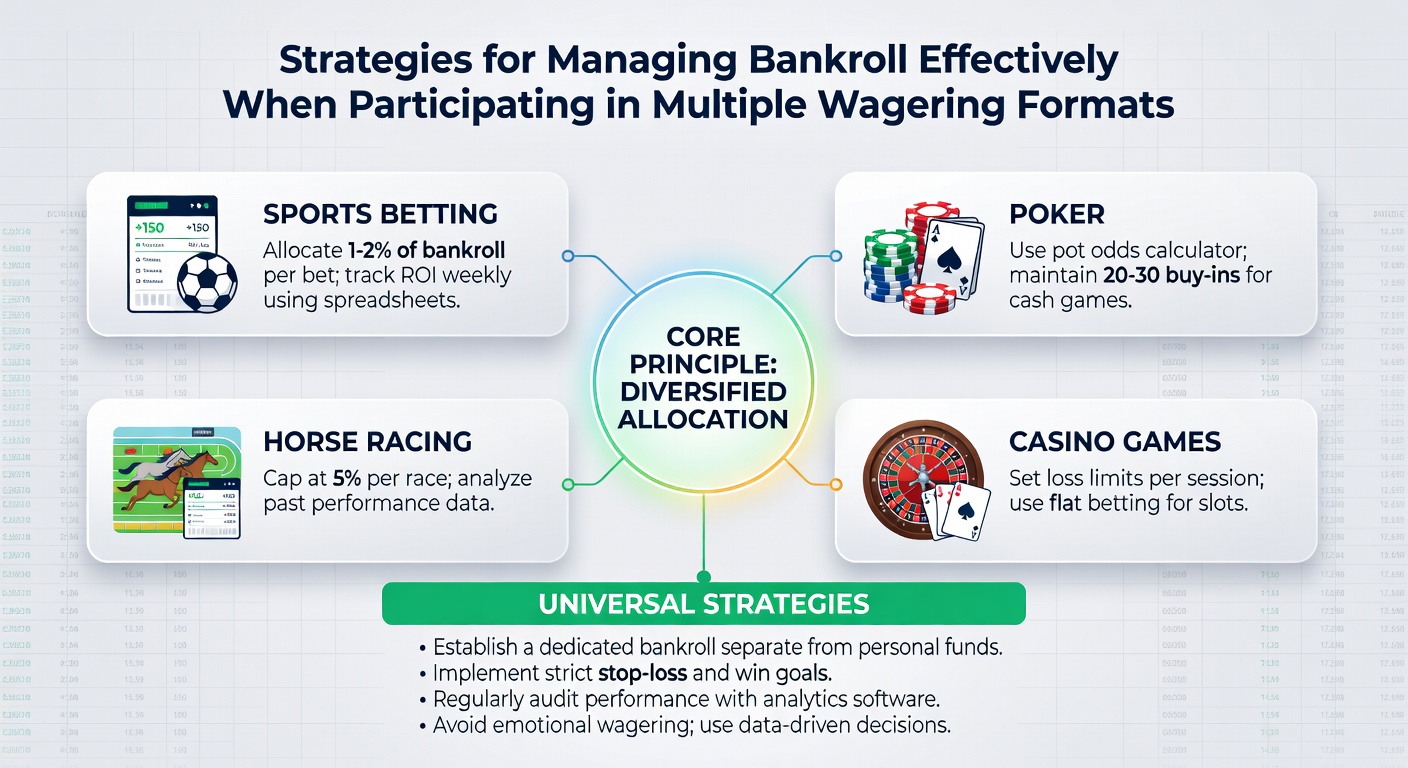
Many experienced participants divide total capital into fixed percentages before placing any wagers. A common structure assigns 60 percent to sports betting lines, 25 percent to table games or slots, and 15 percent to specialized markets such as political or entertainment events. Adjustments occur quarterly based on performance data rather than intuition, and records kept by the Nevada Gaming Control Board demonstrate that such scheduled reviews correlate with steadier account balances over 18-month periods.
Within each segment, further subdivision occurs by risk tier. High-variance bets receive smaller portions, while lower-variance selections receive larger but still capped allocations. This layered method prevents one losing streak in a single format from cascading into others, and industry reports confirm the pattern holds across both retail and online environments.
Real-Time Monitoring and Adjustment Protocols
Continuous oversight replaces periodic checks in advanced setups. Mobile applications now sync across multiple licensed platforms to display combined exposure, and alerts trigger when any single format exceeds its daily threshold. According to data compiled by iGaming Ontario, accounts using automated stop-loss functions show 30 percent fewer instances of rapid depletion compared with manual tracking alone.
Seasonal factors influence these protocols. During major tournaments or promotional periods in May 2026, operators report temporary increases in cross-format traffic, prompting users to tighten percentage limits temporarily. Those adjustments rely on historical variance data rather than current momentum, which helps maintain consistency.
Integration of External Data Sources
Bettors incorporate statistical models from academic and regulatory sources to refine allocation percentages. Studies published through the University of Melbourne examine volatility patterns across wagering types, providing benchmarks that participants apply when recalibrating their own distributions. Similarly, quarterly summaries released by the New Jersey Division of Gaming Enforcement supply aggregate loss ratios that inform conservative reserve requirements.
Cross-referencing these external figures with personal records creates a feedback loop. When actual results diverge from modeled expectations, users shift capital between categories or reduce overall exposure until alignment returns. This evidence-based method avoids reactive decisions and supports sustained participation across formats.
Conclusion
Effective bankroll management across multiple wagering formats rests on segmentation, percentage controls, automated monitoring, and integration of verified data sets. Regulatory statistics and academic analyses continue to validate these practices as participation in combined sports, casino, and prediction markets expands through 2026. Those who implement structured systems consistently demonstrate greater longevity in their chosen activities.